

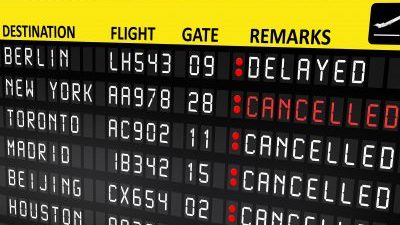
Airline Strike Action: Are you clear about your rights?
A PLAIN SIMPLE GUIDE to dealing with Air Travel Disruption
Whether you’re a solo traveller or travelling with family or friends, delays, cancellations, strike action and more recently unprecedented worldwide travel disruption as a result of Coronavirus can all be a hugely disheartening start to a trip that you have been looking forward too. If you’ve booked a flight that departs from any airport in Europe or you’ve booked a flight with a European airline though you’re protected by the ‘Denied Boarding Regulation’ (also known as the EU Regulation 261/2004), so its vital to understand your rights.
If your flight is one of those delayed or cancelled as a result of strike action or Coronavirus, make sure you know your flight compensation rights are whatever the circumstances so that you aren’t left out of pocket.
YOUR RIGHTS & WHAT YOU’RE ENTITLED TO. HEADLINE SUMMARY FOR SOLO TRAVELLERS
Looking out for us – who’s responsible?
The official government backed body responsible for the regulation of aviation safety in the UK and a whole host of responsibilities including the management of the ATOL financial protection scheme for holidaymakers is the CIVIL AVIATION AUTHORITY (CAA)
They’re also responsible for making sure that consumers have choice, value for money and are protected and treated fairly when they fly,
The CAA advise that whilst airlines do their best to avoid disruption and delays (as we’ve seen recently), problems do occur. If the flight you’ve booked is delayed or cancelled, there are things you can do to make the disruption more bearable. So following the headline checklist t above, it’s important to understand your rights and make sure your airline treats you fairly. Here’s the CAA’s official advice:
The official advice. What to do when your flight is disrupted or cancelled.
Whilst we’re still a member of the EU, under EU law, you have significant rights on many flights to, from or within the European Union, Iceland, Liechtenstein, Norway & Switzerland also operating under this law. These are flights that are:
– departing from an EU airport and operated by any airline, OR
– arriving at an EU airport and operated by an EU airline
1. FIND OUT WHEN YOU WILL BE ABLE TO FLY
If your flight has been delayed or cancelled, try to find out when your airline will be able to fly you to your destination. If the airport and air carrier aren’t already giving you regular updates, ask at the airport, check the airline’s website (often the quickest way) or call them and/or the hotline number they may have set up.
2. DECIDE WHETHER YOU STILL WANT TO FLY
If you are a transfer passenger you are also entitled to a flight back to your original departure point, – so you’re not stranded.
Once you decide to take a refund or to travel later than the first available flight, your airline has no obligation to provide you with food, drink or accommodation. If you are on a package holiday and you decide not to travel on your outbound flight, you may lose your holiday too.
3. YOUR AIRLINE MUST GET YOU THERE
If you still want to fly then your airline must get you to your destination. You may have to be very patient while they rearrange flights and re-book passengers, but the law says they must get you there.
Sometimes airlines may advise you to make alternative travel arrangements, then claim back the cost later. If you go for this, try to keep costs down as much as you can, keep receipts and record the name of the person giving this advice and book with the same airline if its at all possible.
4. MAKE SURE YOU GET LOOKED AFTER
Once your flight has been delayed for a certain amount of time, your airline must take care of you by providing food, drink, access to communications and accommodation (if you are delayed overnight).
- The length of time before this ‘certain amount of time’ kicks in depends on the type of your flight; more than 2 hours for short-haul flights of under 1,500km, 3 hours or more for medium-haul flights, of 1,500km – 3,500km, 4 hours or more for long-haul flights.
At these points this means that they must provide travellers with a reasonable amount of food and drink (normally provided in the form of vouchers), a means for you to communicate (often by refunding the cost of your calls), accommodation, if you’re delayed overnight, transport to and from the accommodation (or your home, if you are able to return there)
The airline must provide you with these items until it is able to fly you to your destination, no matter how long the delay lasts or what has caused it.
The CAA also advise that if you can, it’s usually best to head home when your flight is severely delayed. Your airline should pay reasonable travel costs.
Sometimes airlines are unable to arrange care and assistance for all the passengers affected by delays or strikes i.e. when staff are stretched during major disruption. Should this happen to you, the CAA advise that you have the right to organise reasonable care and assistance yourself, then claim the cost back later. If you end up paying for things yourself, keep every receipt and do not spend more than is reasonable. Airlines are unlikely to refund you for things like luxury hotels or alcohol. Some will provide guidance on reasonable costs.
If the airline your travelling with refuses to provide care and assistance organise it yourself and claim the cost back later. Always keep receipts in this situation and bear in mind it can take time to complain and get your money back.
Keep as much evidence as you can
If your flight is severely delayed you may also be entitled to compensation, so keep as much evidence of the delay as you can, boarding cards, documents, full receipts etc through to names of staff you speak to and records of conversation. If a member of airline staff tells you to make your own arrangements, note when, where and who said this, and ask them to put a note on your booking to this effect.




Leave A Comment